
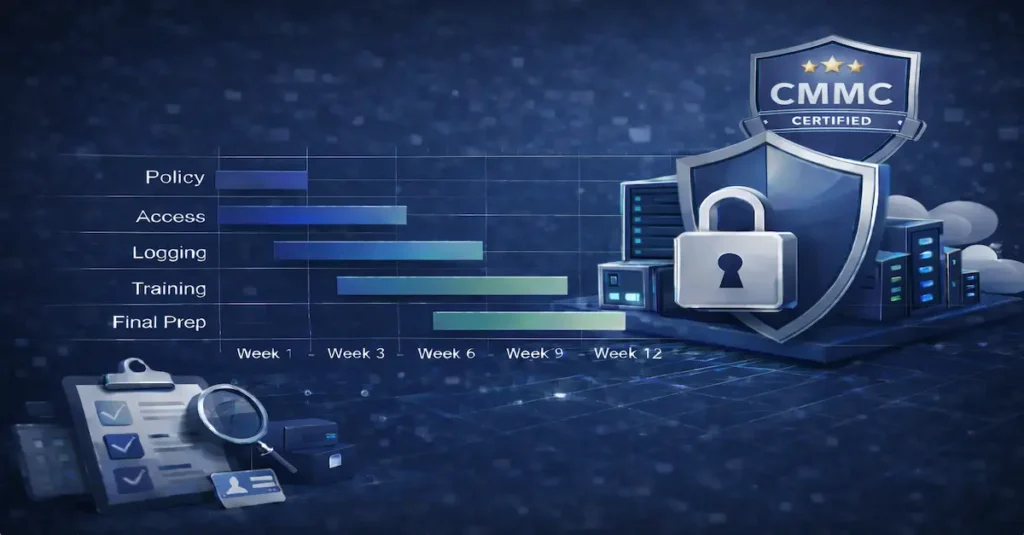
CMMC Level 1 Plan: Not Theory—Proof
Praetorian Secure | NIST-first, no-jargon. Pass audits. Reduce risk. Move faster.
For DoD contractors, CMMC Level 1 isn’t about theory—it’s about proving you can protect Federal Contract Information without slowing down your business. However, the real challenge isn’t understanding what CMMC requires. Instead, it’s knowing how to implement those requirements quickly, correctly, and in a way you can confidently defend when a prime contractor or customer asks for proof.
Why Most Teams Struggle with CMMC Level 1
That’s exactly where many organizations get stuck. They know the requirements exist, but they lack a clear, time-bound plan to turn those requirements into real, defensible controls—especially with limited internal resources.
That’s exactly where this article comes in.
What This 12-Week CMMC Compliance Roadmap Covers
In this guide, we walk through our 12-week, vCISO-led approach to achieving CMMC Level 1—step by step. Along the way, you’ll learn what to focus on each week, which controls matter most, what evidence to collect, and how to avoid the common mistakes that cause teams to stall or redo work later.
Just as importantly, we show you how to lay clean, intentional groundwork for CMMC Level 2, so the work you do now doesn’t get thrown away down the road.
Why Praetorian Secure Takes a Different Approach
For context, we’ve been delivering NIST-guided compliance programs since 2009 for Fortune 10/100 companies and DoD suppliers alike. As a result, our approach is practical, hands-on, and built for real operating environments—not checklists or shelfware.
No bureaucracy.
No unnecessary tools.
Just clear execution, documented proof, and a program you can maintain with confidence.
If You Want CMMC Level 1 Done—Not Just Assessed
Ultimately, if your goal is to complete CMMC Level 1—not just receive another assessment report—this vCISO CMMC roadmap shows you exactly how to get there.
In this Blog:
What CMMC Level 1 Readiness Requires vs. CMMC Level 2 (Quick Primer)
- CMMC Level 1 protects FCI with essential practices: clean access control, basic logging, secure configs, and user training.
- CMMC Level 2 aligns to NIST SP 800-171 for CUI. Our plan builds L1 now while designing forward so policies, logs, and training scale toward L2 without rework.
The 12-Week vCISO CMMC Roadmap
Week 0 – Kickoff & Governance
Goal: Stand up the program; define scope and authority.
- Confirm contract numbers, primes, sites, and in/out-of-scope systems.
- Name the vCISO as Program Owner; identify an ISSM/technical lead.
- Create a RACI (vCISO, IT, HR, Procurement, Facilities, Exec Sponsor).
Artifacts: Charter memo, stakeholder list, RACI, comms plan.
Week 1 – Scope & Data Flow (FCI/CUI Boundary)
Goal: Draw the line around FCI today and potential CUI tomorrow.
- Inventory assets: endpoints, servers, SaaS, cloud, OT/IoT.
- Map data flows: where FCI lives; where CUI would land if won.
- Evaluate enclave options (separate domain/VPC/Azure subscription).
Artifacts: Asset inventory, boundary diagram, data flow map.
Week 2 – Core Policy Set (Designing Forward)
Goal: Publish a lean policy set that satisfies L1 and anticipates L2.
- Approve: Access Control, Acceptable Use, System Hardening, Logging & Monitoring, Incident Response, Backup/Recovery, Security Awareness & Training, Vendor Risk.
- Add procedures: password/MFA, onboarding/offboarding, remote access, removable media, patching cadence.
Artifacts: Signed policies, version control, distribution attestations.
Week 3 – Access Control Implementation
Goal: Enforce least privilege and account hygiene.
- Unique accounts for all users/admins; end shared logins.
- MFA for admins, remote access, and critical systems; document enforcement.
- RBAC groups; review high-risk privileges; restrict remote mgmt.
Artifacts: IdP/AD screenshots, MFA policy, group exports, review sign-offs.
Week 4 – Logging & Monitoring Baseline
Goal: Turn on the lights so you can prove control.
- Centralize logs (auth, privilege changes, endpoint alerts, firewall, VPN).
- Enable time sync, retention, and alert routing.
- Document a simple daily/weekly review with evidence capture.
Artifacts: Logging diagram, alert runbook, review checklists, sample tickets.
Week 5 – Secure Config & Patch Management
Goal: Build secure defaults and reliable updates.
- Apply hardened baselines (e.g., CIS-style) to workstations/servers; MDM for Macs.
- Patch OS and third-party apps to a defined SLA; auto-update where possible.
- Deploy EDR/AV; restrict macros; disable unnecessary services.
Artifacts: Baseline configs, MDM profiles, patch reports, EDR console screenshots.
Week 6 – Security Awareness & Role-Based Training
Goal: Train users and admins; prove it happened.
- Annual security awareness + phishing module for all users.
- Role-based admin training: privileged access hygiene, logging, backups.
- New-hire onboarding checklist tied to policy acknowledgment.
Artifacts: Curriculum, LMS completions, sign-in sheets, attestation records.
Week 7 – Vendor & Remote Support Controls
Goal: Tame third-party risk and remote access.
- Inventory vendors touching FCI/CUI; track data access & security commitments.
- Require MFA, encryption, and session recording for remote tools.
- Add security clauses to SOWs/POs; maintain a vendor register.
Artifacts: Vendor inventory, security addenda, remote access policy, session logs.
Week 8 – Incident Response Plan + Tabletop
Goal: Detect, respond, recover—and show your work.
- Publish an IR plan with severity matrix, roles, comms tree, forensics triage.
- Run a 60-minute ransomware tabletop; produce action items.
- Define evidence handling and notification triggers.
Artifacts: IR plan, tabletop results, improvement tickets.
Week 9 – Backup, Recovery & Business Continuity
Goal: Prove you can restore fast.
- Enforce 3-2-1 backups with offline/immutable copies.
- Test restores for critical systems; document RTO/RPO.
- Protect backups with MFA and separate credentials.
Artifacts: Backup architecture, test-restore screenshots, runbook, RTO/RPO record.
Week 10 – Evidence Packaging & Mini-SSP
Goal: Organize proof for L1 and future L2.
- Build an Evidence Matrix mapping practices → artifacts.
- Draft a mini-SSP describing scope, roles, technologies, and key controls.
- Start a POA&M for any L2-oriented gaps you’re deferring.
Artifacts: Evidence Matrix (xlsx), mini-SSP (doc), POA&M tracker.
Week 11 – Self-Assessment & Management Review
Goal: Validate implementation; lock in governance.
- Perform a structured L1 self-assessment; sample controls.
- Management review: metrics, residual risks, POA&M acceptance.
- Prepare customer/prime responses and a simple compliance statement.
Artifacts: Report, meeting minutes, risk register, approval memo.
Week 12 – Attestation & Level-2 Readiness Plan
Goal: Attest to L1 and show a credible path to L2.
- Finalize documentation package for customers/primes.
- Publish a 6–12 month L2 roadmap: deeper logging, vuln mgmt, change control, secure SDLC (as applicable).
- Budget & resourcing plan (internal vs. managed services).
Artifacts: Attestation packet, roadmap deck, budget worksheet.
Fast-Track Controls for Level 1 (That Also Help CMMC Level 2)
- MFA for admins, remote access, and critical apps.
- Least privilege with RBAC and quarterly access reviews.
- Centralized logging (auth/privilege/firewall/EDR) with weekly review.
- Secure configurations via MDM/GPO; minimize local admin.
- Patch within SLAs (e.g., critical < 14 days) and keep reports.
- EDR/AV with alerting and documented response.
- 3-2-1 backups + regular test restores.
- Security awareness training with phishing drills.
- Harden remote access/support tools; restrict by IP and time.
- Vendor controls with security clauses and access tracking.
Evidence You’ll Need (Keep This Binder!)
- Signed policy set and user acknowledgments.
- Screenshots/exports: MFA settings, RBAC groups, EDR console, SIEM queries, firewall/VPN settings, backup jobs, patch status.
- Training records and phishing results.
- IR plan + tabletop report and improvement tickets.
- Asset inventory, boundary diagram, data flow map.
- Mini-SSP and POA&M (for Level 2 planning).
Light-Weight Tooling Stack (Vendor-Agnostic)
- Identity & Access: Cloud IdP with MFA, RBAC, conditional access.
- Endpoint & Config: EDR/AV, MDM/GPO, CIS-style baselines.
- Logging: Centralized log repository or SIEM-lite; time sync everywhere.
- Vulnerability & Patching: OS + third-party updates; monthly scans.
- Backup: Immutable/offline copies; quarterly restore test.
- Training: LMS or managed awareness program with phishing.
KPIs for the Executive Dashboard
- MFA coverage (% of privileged users, remote access, critical apps)
- Patch compliance (% endpoints within SLA)
- Backup success (daily success rate; last successful restore date)
- Training completion (% users; phishing failure rate)
- Log review cadence (on-time % and findings closed)
Common Pitfalls (and Fast Fixes)
- Policies without proof: Schedule attestations and capture distribution logs.
- MFA exemptions: Use break-glass accounts with vaulting and monitoring.
- Unscoped vendors: Add security clauses; limit remote support; log sessions.
- No restore tests: Automate monthly small-file and quarterly full restores.
- Shadow IT: Use SaaS discovery; require security review pre-adoption.
Most CMMC firms tell you what to fix. Praetorian Secure helps you actually fix it.
Our 12-week vCISO program is designed to get DoD contractors to CMMC Level 1 quickly, without unnecessary tools, paperwork, or disruption. We implement the controls with you, build the evidence as we go, and leave you with a program that works in the real world—not just on paper.
Built for busy DoD contractors: clear execution, clean evidence, and a program your team can actually maintain.
| What actually matters |
Praetorian Secure (12-Week vCISO Program) Recommended for Level 1 in 12 weeks |
Assessment-Only Firms |
|---|---|---|
| Primary focus |
Finish Level 1 and produce proof (evidence) as you go.
|
Deliver a report / score and a list of gaps to fix later.
|
| Approach |
Hands-on implementation with your team (vCISO-led).
|
Review, advise, and recommend (you implement).
|
| Who does the work |
We work alongside your staff and drive weekly execution.
|
Your internal team is left to figure out timelines and owners.
|
| Policies & documentation |
Policies built to match how you actually operate (not shelfware).
|
Templates and reviews—often not fully operationalized.
|
| Access control |
Implemented, tested, and verified (MFA, least privilege, onboarding/offboarding).
|
Commonly reviewed—enforcement varies by client follow-through.
|
| Logging & monitoring |
Turned on, centralized enough to be useful, with a repeatable review process.
|
Often “discussed” but not proven with consistent evidence.
|
| Security training |
Delivered, tracked, and documented (so you can prove completion).
|
Recommended or lightly reviewed—evidence may be incomplete.
|
| Evidence package |
Built week by week so you’re not scrambling at the end.
|
Usually left for “after the assessment.”
|
| End-of-project outcome |
Compliant + provable (you can show primes what you’ve done).
|
“Here’s what to do next” report.
|
| Readiness for Level 2 |
Designed forward so Level 1 work isn’t wasted when Level 2 arrives.
|
More rework later if the “fixes” weren’t implemented cleanly.
|
Plain-English takeaway: If you want a report, assessment-only firms can help. If you want CMMC Level 1 completed in 12 weeks with evidence you can show, this is what Praetorian Secure is built for.
Need CMMC Level 1 done—not just assessed?
Our 12-week vCISO program is built to get you compliant and ready to prove it
Why This Matters for DoD Contractors
Most DoD contractors don’t fail CMMC Level 1 because the controls are complicated. They fail because no one is responsible for making the changes stick.
Assessment-only firms are valuable when you already have a mature security program. But if your goal is to meet CMMC Level 1 requirements quickly, cleanly, and without disruption, you need a team that can lead execution—not just point out gaps.
That’s why Praetorian Secure uses a vCISO-led implementation model:
One accountable security leader
A clear weekly plan
Real progress you can see
Evidence that holds up under scrutiny
FAQs
How long does CMMC Level 1 really take?
Most SMBs can complete it in about 12 weeks with vCISO CMMC leadership if they commit resources. Multi-site or tooling rollouts may need extra time.
Do I need a full 800-171 SSP for Level 1?
No. A concise mini-SSP now saves time moving to Level 2 and helps customers understand your control environment.
Can a vCISO satisfy customer expectations?
Yes. What matters is mature practices and solid evidence—not whether the security leader is full-time or virtual.
What if we handle CUI later?
Design forward: plan a segmented enclave during Weeks 1–2 so adding CUI later doesn’t force a full redesign.